
WHY WE ARE THERE
Why we exist
The Institute is a strategic response to the multi-faceted social, economic, political and ecological crises facing post-colonial societies (primarily in Southern Africa). Since the end of colonialism and apartheid, all these societies have witnessed the hollowing out of democratic institutions, violations of basic human rights, disabled popular movements, rule by self-interested political elites using their power for their own private benefit, untransformed economies that have not fundamentally changed the socio-economic conditions of the majority, worsening underdevelopment and inequality, the continued marginalisation and oppression of women and other social strata (such as LGBTQIA+ communities), the use of state violence and repression for social control, and the emergence of alliances and relations that connect political elites with conservative religious forces, tribal chiefly elites, other traditionalist fundamentalists, and private businesses.
Alongside these negative features, these societies have also seen the emergence of popular movements and civil society voices, initiatives, self-organisation and alternatives that seek to mobilise the mass of ordinary people for progressive social, economic and political change, and in response to ecological crises. But these have remained focused on their immediate, here-and-now single-issue struggles with insufficient attention paid to structural transformation, broader alliances and solidarity, and the need for longer-term strategies.
To solve these crises, strategic action is required. The Zabalaza Pathways Institute is such a strategic initiative offering a bold programme of action to enable ordinary people to consolidate and harness their fears, frustrations, desires and hopes into transformative action to address these crises.
As the Zabalaza Pathways Institute, we believe that it is primarily through catalysing, strengthening and sustaining a critical mass and momentum of bottom-up grassroots people’s self-agency and organisation that Southern African societies can sustainably address the crises they face. Further, we also believe that organised, democratic, vibrant and mass-based formations of marginalised communities and workers must collectively shift from short-term, single-issue strategies towards long-term transformative strategies to win universal, thorough-going change. The Institute works to facilitate a shift towards this strategic orientation amongst a diversity of community and worker organisations and movements.
Programmes
We undertake our primary movement-support work through our Social Justice LAB for Strategy, Learning and Action. In this LAB, we work with movements advancing the strategic goals of:
- Economic Justice;
- Ecological Justice; and
- Deepening Democracy
Economic and Ecological Justice
We work to advance people-driven, and people-centred development to achieve universal well-being through a deep just transition to a zero carbon economy. We support movements that collectively seek to achieve the following outcomes:
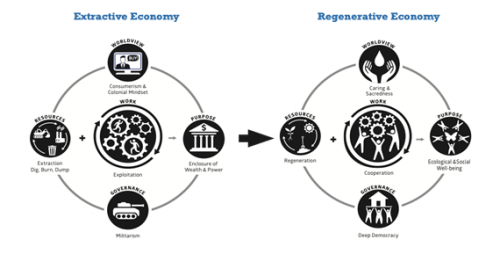
- People-driven democratisation of economic development based on the principles of cooperation, solidarity, sustainable livelihoods, work for the common good, regenerative circular economies, universal human rights and universal access to decent living standards;
- Transformation of gender relations through a radical feminist approach to ecological and economic justice;
- Basic needs to achieve universal access to a core basket of human capabilities and these provided as quality public goods and services – in particular education, health, transport, communication, development infrastructure, a universal basic income grant, decent social security and sustainable public employment schemes;
- Reclaiming the commons from below; and
- Socially owned renewable energy; and
- Food justice based on land and agrarian reform, food sovereignty, agroecology and democratised food system value chains.
Graphically, our economic and ecological justice framework is represented as follows:
Deepening Democracy
We partner with and support movements that seek to achieve the following:
- Fix Our Municipalities – reclaim municipalities from below;
- Rural democracy – to protect the rights of women, youth, LGBTQIA+ people and other vulnerable groups under the nub of unaccountably tribal chiefly elites and the unjust laws that perpetuate the oppressive legal framework inherited from colonial and apartheid eras;
- Transformative constitutionalism from below – defence of rights and equality, substantial progress in advancing socio-economic rights, testing the transformative limits of the Constitution and laying the ground for progressive amendments of the Constitution
- Political reforms that deepen democracy – through:
- Deepening electoral reform focusing on enabling any member of society to exercise their democratic rights to stand for election into public office without any unfair and unjust hindrance;
- Fighting for and winning the right, ability and power of the public to petition for legislative proposals;
- Fighting for and winning the right of the public to recall elected representatives;
- Promoting the strategy and power of the public to undertake social audits of the work of government and the legislative assemblies; and
- Deepening meaningful and substantive public participation in legislative and governance affairs from the perspective radical direct democracy.
These programme pillars are the most strategic for realising our vision of people-driven transformative justice. Beyond these programmes, we also undertake strategic initiatives in response to the complex and unfolding critical political and socio-economic context (e.g. the crisis of democracy, racism, nation-building, xenophobia, social unrest, activist killings, international solidarity, and fundraising for social justice).
FIX OUR MUNICIPALITIES INITIATIVE
The Fix Our Municipalities Initiative (FOMI) mobilises communities, grassroots organisations, and local civil society into a coordinated, sustained and transformative effort to ensure public participation and oversight over municipal affairs. This is done in order to ensure that municipalities meet their constitutional mandate for service delivery and public goods, local economic development and transformation of apartheid geographies.
We currently work with the Unemployed People’s Movement and the Makana Citizens Front in the Makana Local Municipality, as well as the Independent Komani Residents’ Association and the Hewu Rural Community Forum in the Enoch Mgijima Local Municipality.
We have also begun work with Nelson Mandela Bay Water Crisis Committee. We have also undertaken preliminary consultations with more than 20 social justice organisations in the City of Cape Town.
By the end of 2025, this work will reach a total of 7 other strategic municipalities across the country – possibly including the Amathole District, the Bitou Local Municipality, the City of Cape Town, the City of Johannesburg, the eThekwini Metropolitan Municipality, the Nelson Mandela Metropolitan Municipality and the Mangaung Metropolitan Municipality.
WIDESPREAD MUNICIPAL CRISIS
The last local government elections took place in November 2021. This means that by the end of 2023 there will be 3 years left before the end of the current mandate for all of the 278 municipalities in South Africa (comprising 8 metropolitan, 44 district and 226 local municipalities). Almost all these municipalities are characterised by systemic and structural crises which result in poor service delivery for the black working class majority, hollowed out democracy as we see in the generalised distrust in the limited public participation system, untransformative municipal development plans and budgets which reinforce neo-apartheid spatiality and living conditions, corporatisation of service delivery and other municipal functions, widespread corruption, maladministration and mismanagement, and the factionalised use of municipal resources for personal power and accumulation. The Eastern Cape province bears the brunt of the worst of these crises.
HOLLOWING OUT DEMOCRACY
The biggest void and absence in this municipal system is organised people’s power that has effect and impact on how municipalities work. Indeed, there are often regular protests, court cases and other mass activity focused on these crises. There are only a few exceptions where such mass activity has been sustained in impactful ways. Even these exceptions are often isolated and severely challenged by a lack of several layers of activists and leadership from within the self-organised communities, a lack of research and policy capacity, a limited analysis of the causes of the systemic and structural aspects of the municipal crises, a short-term vision on the required solutions which are often not to a longer-term perspective and strategy for thorough-going transformation, and are often vulnerable to cooption by the dominant neo-liberal discourse that is hegemonic in the state and most of civil society.

WHAT THE FIX OUR MUNICIPALITIES INITIATIVE IS ABOUT
Key FOMI activities include a 4-module Foundation Course, and a Consultative Conference to launch FOMI as a provincial campaign in the Eastern Cape initially which is intended to grow into a national campaign over time. It is symbolic and strategic for this initiative to start in the Eastern Cape given how this province ranks amongst the lowest in terms of municipal performance and poor governance as if its dire socio-economic development indicators are not enough. Post the Consultative Conference, we seek to build an activism-based, action-based grassroots campaign with vibrancy, impact, and inspiration that coordinates action across the Eastern Cape province, builds solidarity and enables communities to win demands that make municipalities to serve the people, and that also enable the mass of ordinary people to democratically reclaim municipalities from below.
The Initiative supports self-mobilisation and organisation by communities, grassroots organisations, and local civil society. It seeks to harness all this self-activity into a coordinated, sustained and transformative effort to improve service delivery, expose and end corruption, mismanagement and mal-administration, consolidate popular power, build effective public participation, ensure effective public oversight over municipal affairs, and to direct popular power to impact on municipal transformation.
The Initiative will be from existing struggles and immediate demands. Going beyond struggles for reforms to meet immediate demands, the Initiative will build an organising strategy that connects immediate issues with a longer-term agenda for thorough-going change.
- Food for thought: How should activists, movements and communities connect their immediate struggles with building a longer-term agenda for change? How can popular forces connect their immediate demands with a transformative logic that can challenge and roll back the logic of the market at the local state? How do notions of public goods and a social wage become sensible, realistic, desirable and owned by communities, social movements and activists? How do communities and movements connect their struggles with the need for a struggle against austerity? How does the Initiative create conducive platforms to solve these questions concretely in action at the grassroots?